"Compare the audience pleasures offered by two comedy programmes. Give examples from the programmes."
The two comedy programmes The Inbetweeners (2008~2010, E4) and QI (2003~ , BBC2) provide the audience with different types of pleasures due to the differences in their audience and ethos. When compared, QI is considered more mainstream because of its wider range of audience although highly concentrated over the 30 age mark. It can easily appeal to more people and is therefore broadcast on BBC as well as having reruns on other channels as well.
The audience pleasures that QI provides is directly linked to the PSB values of BBC: to inform, entertain, and educate. Although QI's main objective is to entertain the audience through portraying Alan Davies as a lesser being, it also educates the audience through obscure information and unexpected answers. This creates a passageway to another audience pleasure that The Inbetweeners lacks, active communication. QI stars a number of participants who are looking to find the correct answer to the question that Stephen Fry asks, which can then be indirectly engaged by the audience at home. By getting certain answers correct, the audience is more likely to be attracted to the show's momentum and get involved. Although this is true, the audience as well as anyone on the show rarely get answers correct and are bound to feel a lack of knowledge. Because of this, the audience pleasure cannot be successfully achieved without Stephen Fry's welcoming attitude, and taking a softer approach to people's futility.
The Inbetweeners on the other hand provide pleasure to its audience in a completely different manner. To start with, it is a comedy that focuses on a niche-audience of older teenagers and young adults. It is also mainly targeting the male population as the storyline is based around typical teenagers in a school life. This age group is uncommonly interfered by any other because the show contains language which is very disturbing. This has been done so that the show seems as realistic as possible for the audience. The main audience pleasure gained from The Inbetweeners is relations with the characters. People watching the show are often entertained by situations which they can relate to from their school life and laugh at the characters because they know how it feels to be in their shoes.

12.3.13
'Gladiator' Opening Sequence
In the opening sequence of 'Gladiator', narratives which fit the genre of action and adventure take place. First of all, the representation of characters and the two opposing sides make it clear who are the 'good' hero and who are the villains. When the Roman soldiers are being shown, there is a sense of respect and admiration around. This can be seen from how the soldiers address their leader; with gentle bows and suitable behaviors. The Romans also move in an orderly queue and preparing for battle, which shows the human side of the battalion. It is rather obvious who the main 'hero' in the opening sequence is because of the way he is dressed and acts. He has an unlikely good - looking face for a warrior and wears additional clothing above his platebody. He also gives orders in a ruling manner which presents him as someone in a high status. This makes the audience feel supportive towards the Romans and the hero in the pack. The German opposition on the other hand, have old - fashioned kit and act in a disorganised barbaric way. They produce intimidating sounds and have uncomforting images, quite different from the Romans. Their disorientated looks is stereotypical narrative
There is combat involved, which is also a typical action and adventure narrative. As the Germans show up, suspense starts building up and the spectacular scenery provides what is a battlefield for the armies. There isn't alot of speed and motion prior to the battle which shows how calm the Roman soldiers were. The Germans decapitate a Roman messenger which hints that the people there are in jeopardy. This makes the audience feel nervous and more attracted to further events that would take place in the film.
There is combat involved, which is also a typical action and adventure narrative. As the Germans show up, suspense starts building up and the spectacular scenery provides what is a battlefield for the armies. There isn't alot of speed and motion prior to the battle which shows how calm the Roman soldiers were. The Germans decapitate a Roman messenger which hints that the people there are in jeopardy. This makes the audience feel nervous and more attracted to further events that would take place in the film.
11.3.13
Mission Impossible Opening
Mission Impossible 2 is an Action and Adventure film which also carries some characteristics of a thriller. The opening sequence involves a scene where the main character is climbing a cliff with bare hands in a uncivilized place. The narrative in the screening fits the genre of action and adventure. First of all, the background of the opening creates a sense of suspense and nervousness. For instance, when the character jumps from one rock to another and slips to the edge of the cliff, a bird's eye camera shot is used to emphasize the height in which the character is in. This makes the audience worry and makes them feel like part of the film. Also, there are many wide shots to show to the audience the basic image of what kind of place the character has been placed in. The ambient sound of panting additionally presents motion and difficulty in the action involved.
Secondly, a message is delivered from a helicopter to the main character, presenting him with a mission to look for a certain item with help of a civilian around the area. This is very typical of an action and adventure genre film because the message for-sees an adventure that lies ahead of the character. This makes the audience think about what lies ahead and makes connection with the events presented prior to the message. At this point, the audience get the idea that the character is the hero in the genre because he has been chosen for the task. Additionally, he is good - looking which is typical of people on the 'good' side. At the end of the opening is an explosion of the message which is another typical event in an action and adventure film.
6.3.13
About 'The IT Crowd'
The IT Crowd is a British sitcom by Channel 4, written by Graham Linehan, and produced by Ash Atalla. Set in the London offices of the fictional Reynholm
Industries, the show revolves around the three staff members of its IT
department: a geeky genius named Maurice Moss, the workshy Roy Trenneman, and
Jen Barber, the department head/Relationship manager, who knows nothing about IT.
Moss
and Roy, the two technicians, are portrayed as socially inept geeks or, in Denholm Reynholm's words,
"standard nerds". Despite the company's dependence on their services,
they are despised, ignored, and considered losers by the rest of the staff.
Roy's exasperation is reflected in his support techniques of ignoring the phone
in the hope it will stop ringing. He expresses
his personality by wearing a different geek T-shirt in each episode. Moss's wide and intricate knowledge of
all things technical is reflected in his extremely accurate yet utterly
indecipherable suggestions, while he demonstrates a complete inability to deal
with practical problems like extinguishing fires and removing spiders.
Jen, the newest member of the
team, is hopelessly non-technical, despite claiming on her CV that she has "a lot of experience
with computers". As Denholm, the company boss, is equally tech-illiterate,
he is convinced by Jen's interview bluffing and appoints her head of the IT
department. Her official title is "relationship manager", yet her
attempts at bridging the gulf between the technicians and the business
generally have the opposite effect, landing Jen in situations just as ludicrous
as those of her team-mates.
Being
a situation comedy, the audience of ‘The IT Crowd’ gain entertainment from
everyday situations that revolve around the main characters of the show. They are enlightened by the stupidity of the people in the sitcoms and take an upper ground, as smarter people. The show can be watched without much thinking about situations as the sole purpose of the show is to entertain the audiences.
4.3.13
About QI (Quite Interesting)
QI (Quite Interesting) is a British comedy panel quiz show created and co - produced by John Lloyd, hosted by Stephen Fry, and featuring permanent panelist Alan Davies. Most of the
questions are extremely obscure, making it unlikely that the correct answer
will be given.
Stephen Fry as
the host, takes an omniscient position where he leads the show knowing the
answers to the questions presented throughout the game. He then decides whether
he will deduce or award points depending on how interesting the answer given
is. Alan Davies is shown on the show as a permanent member whilst the other 3
people are swapped around every show. He is the centre of humourous abuse, and
also is the first person to give a wrong answer to lead the show.
Because of the show's expectation that hardly anyone would be able to
give a correct answer without significant prompting, it instead encourages
sheer interestingness, which is how points are mainly scored. Negative
scores are common, and occasionally even the victor's score may be negative. As the contestants in the show are
generally 'destroyed' of their existing knowledge, the audience gets a
confidence boost and is embraced by it. They feel they are in a 'smarter'
position, and along with the humour get to enjoy the show.
24.5.12
SITCOM CHARACTER PROFILE
In this session, we each make a character profile of the character that we are playing.
I am playing Mr. Young-Ho Moon, a chef in the restaurant.
I am playing Mr. Young-Ho Moon, a chef in the restaurant.
- Came from Korea to cook exotic dishes.
- Very hard working, devoted to the restaurant
- Short tempered from Brooks not working
- Prop: Chef's hat, white apron, and cooking supplies (Other props to express Korean feeling)
16.5.12
Questions for prep.
2. First of all, the starting soundtrack provides a mysterious atmosphere to the film beforehand. Along with the singing voice, the roar of thunder is heard in the background making it seem dangerous, and as the character's voice kicks in, the mysterious song slowly reaches its peak and suddenly ends, leading to a adventurous tune containing both orchestral and electronic sounds. There is no signature tune for a certain character, but the tone of the music diverts as different scenes come and go.
The camerawork features numerous angles commonly used in an action and adventure film, and also films in general. The start of the trailer is a wide shot featuring a mysterious man in the rain. This adds curiosity to the future events, and serves as a profound start. There are high angle shots focusing on the castle and a bird's eye view of the playing field to increase visual size. The ship is taken from a low angle shot to make it look as if it's an extremely great feature almost as if it's the arrival of a very high ranked person. There are extreme wide shots to show the size of the maze, and close ups on the main character to clearly show expressions.
The editing in the trailer mostly includes special effects in magical spells and computer graphics of exotic monsters such as dragons and mermen. The people flying on broomsticks conveys the image that the place is indeed 'magical' and this effect is equally achieved from the ship coming from under the sea as well as flying horses. People breathing fire is a computer graphic effect of showing power, and imaginary creatures are made in the same way. The combat spells used in the trailer not only show the capability of wizards but also the fact that the film contains action along with fantasy.
The most significant mise-en-scene in the film is the exotic places that the adventure takes place. The tasks that the character has all have different backgrounds and the content of what must be done. This produces a magical setting to a adventurous quest. Also, the fact people fly on broomsticks shows a stereotypical idea of a wizard world.
3. In the trailer, people are not only presented in a stereotypical way but also a factual way. As long as the setting is a 'school', the students are all formally dressed in school uniforms to express as if it was the actual reality. In contrast to the 'nice house' of Gryffindor, the 'evil house' of Slytherin is consisted of people that actually look like bad people with smirks and hatred written on their faces. Even though the story is based throughout a school, these little bits of expression change the atmosphere of the tale. The main character stands out between everyone with focused views and a frequent presentation.
4.5.12
27.4.12
Completed essay
Garry Na 1183 Claremont Fan Court School 64680 June 2012
OCR Media Studies J526 Individual Media Studies
Portfolio B321
A
Comparison of how women have been represented in fragrance advertisements from
1920s, 1990s, and 2011.
Mavis by Vivaudou (Print 1920s)

The focus of the representation is on
the woman performing a pose like a dancer. This is observed from the fact that
the woman is being held up by the character dressed as a pier rot and that the
woman represented is stretching out her arms the same way a ballet dancer
would. This is a theatrical illustration in a way that the use of this
fragrance allows women to be a part of a "show" the same way the
represented woman would. The woman is dressed in a bright gold skirt which is
reflecting the delicacy in her fashion and its wideness is imaging the woman
like a swan along with her highly stretched arms. Her shoes match the golden
design of the skirt and its unique and sophisticated design is an impressive
figuration of the Art Nouveau style. Her theatrical illustration in this advert
match the way she is dressed and it's a major cause the woman is 'irresistible'
as the advert suggests.
We also observe the oriental
representation in the architectural format of the building surrounding the
woman. The main focus of this advert from the presentation of an oriental
style is a message of co-existence with the European environment around
it. What this would refer to is the fact that such contrasting position is
presenting an opportunity for the users of this fragrance to experience the
traditional East Asian styles along with the use. Possibly and most likely,
this would be a crucial attraction to women who have placed their interests in
the Oriental scent. The shadows that cover the arc proves to the observers
that the print advert is not just a print, but rather provides a feeling that
we are actually in the midst of the experience of the orient. The architect
makes a perfect parallel to the women's skirt and doesn't give us the feeling
that the co-existence of the Oriental feeling along with a European one is
awkward.
Reds for Men by Giorgio Beverly Hills (Print 1990s)
My second choice, Red
for Men, forms a great
contrast to Vivaudou’s Mavis advertisement in its representation of
women. Where the female in Mavis is considered the epitome of feminity in her
dainty and balletic pose, the female in the Red
for Men advert is featured as
almost masculinised in the fact that she is taking a predatory and an assertive
pose. This is derived from the motion her body is taking such as grasping the
man’s hair as if to control him and taking the higher stance in their
relationship. Whilst in the Mavis advert, the woman  was
presented more as a controlled figure in contrast to the man in the pier rot
outfit, the Red for Men advert presents her as the person in command.
was
presented more as a controlled figure in contrast to the man in the pier rot
outfit, the Red for Men advert presents her as the person in command.
 was
presented more as a controlled figure in contrast to the man in the pier rot
outfit, the Red for Men advert presents her as the person in command.
was
presented more as a controlled figure in contrast to the man in the pier rot
outfit, the Red for Men advert presents her as the person in command.
Also, as the Mavis advert shows an
idealised romantic image of the woman, the Red for Men portrays a different image. In the Mavis
one, it has been stated that the whole atmosphere of the advert is giving us a
theatrical feeling due to the woman's stance and the art nouveau style of her
clothing and surroundings, as if by using the fragrance a woman would feel they
were being involved in a fantasy world. However, Reds for Men shows a direct contrast. The woman in
the advert is of an earthly image with her short hair and strong possessive
stance. She is somewhat taking the image of a man in the way she is portrayed
as a strong figure and she shows a great want showing a unique side of the
fragrance’s attraction.
Furthermore, the woman represented in Reds for Men is significant in the fact that
she is undressed along with the man to disperse sexuality and a sense of
joyfulness. An achievement of this illustration is to indoctrinate the
observers that they are at a beach or a summer holiday sort of location. This
convinces people in a sense that, 'If fun is what you are looking for, this
fragrance will do the job'. Not only does being undressed give you the feeling
of enjoyment and interest, but this is also a good way of presenting sexuality
and grasping extreme awareness, leading to the purchase of the fragrance. Such
illustration is not noticed from the Mavis
Vivaudou print advert, and
this is from the fact that the timeline of 1920s focuses on theatrical
attraction rather than natural sexuality.
Cherie by Miss Dior (Moving
Image 2011)
 The third advert that
I chose is Miss Dior Cherie.
This advert concentrates more on the representation of freedom from being
dependant on anyone to make her happy. This is much like a post-feminist
assertion of independence that
women will experience unlike the first and second advert which describes the
attraction the user might experience from it. The advert has a 'main colour' of
pink to show an elegant and soft image of French sophistication. From the
woman's clothings to the backgrounds of the scene, the woman is portrayed as if
she is in her own world that was created for her to enjoy. The information that
is passed on from the advert is that the fragrance allows the user to enjoy
life the way the model in the advert does. This is a very well portrayed
engagement with the busy lifestyles of today and creates another sense of
attraction for women to be interested in.
The third advert that
I chose is Miss Dior Cherie.
This advert concentrates more on the representation of freedom from being
dependant on anyone to make her happy. This is much like a post-feminist
assertion of independence that
women will experience unlike the first and second advert which describes the
attraction the user might experience from it. The advert has a 'main colour' of
pink to show an elegant and soft image of French sophistication. From the
woman's clothings to the backgrounds of the scene, the woman is portrayed as if
she is in her own world that was created for her to enjoy. The information that
is passed on from the advert is that the fragrance allows the user to enjoy
life the way the model in the advert does. This is a very well portrayed
engagement with the busy lifestyles of today and creates another sense of
attraction for women to be interested in.
The woman in the advert
carries a free spirit allowing her to carry out what she desires to do. From
the start to the end of the advert, every second illustrates the open life that
the woman is enjoying. For example, in the scene where the woman is walking
across the bridge, we realise that she has an elegant smile over her face and
her posture represents her freedom of belonging to where she is. As the advert
moves on, she designs her own dress, rides a bike along the city, and tries out
what she wants to. This acts as an incentive for people with busy lives to
realise the message that life is there to enjoy. She never loses her smile
throughout the advert and this is a sign of her bliss and happiness.
 Furthermore,
the Miss Dior Cherie advert has the main theme colour
of pink which is a representation of girlish and daintiness. Throughout
the advert, numerous objects and background settings carry the colour of pink
which is a unique characteristic that this fragrance wants to represent. What
the advert wants to conclude from the use of such a bright yet soft colour is
the presentation of a dainty image the user will contain. This characteristic
can be compared to the Mavis
Vivaudou which represents the
woman as dainty from the use of her pose as a ballet dancer as well. This
proves that the Miss Dior
Cherie is trying to portray
the woman in an elegant yet old-fashioned way which shows a highly
contrast to representations from the 1990s such as the Reds for Men print advertisement.
Furthermore,
the Miss Dior Cherie advert has the main theme colour
of pink which is a representation of girlish and daintiness. Throughout
the advert, numerous objects and background settings carry the colour of pink
which is a unique characteristic that this fragrance wants to represent. What
the advert wants to conclude from the use of such a bright yet soft colour is
the presentation of a dainty image the user will contain. This characteristic
can be compared to the Mavis
Vivaudou which represents the
woman as dainty from the use of her pose as a ballet dancer as well. This
proves that the Miss Dior
Cherie is trying to portray
the woman in an elegant yet old-fashioned way which shows a highly
contrast to representations from the 1990s such as the Reds for Men print advertisement.  Additionally,
the Miss Dior Cherie advert focuses on the dream and
fantasy that the user will experience from the fragrance. All the events in the
advert not only show the image of a, ‘free woman’ but also, the representation
of a woman in her fantasy world. The advert shows scenes of the woman riding
her bike unreservedly inside the city, meeting the dream man of her life, and
flying over the city of Paris on a bundle of colourful balloons. Nothing in her
world can disturb her from her freedom and allows her to do whatever she
desires. This can be compared to the first two print adverts which both
represent the women as full of freedom and fantasy. Especially in the Mavis Vivaudou advert, the theatrical
representation is a comparison factor to the Miss
Dior Cherie woman and her
fantasy dream. Even though the city is full of cars and is clearly a busy
background, the woman rides freely with a graceful smile on her face. One of
the most significant events in the advert is her confrontation with the dream
man of her life. This is because after she sprays the Miss Dior Cherie perfume
on herself, the man she has dreamed of arbitrarily appears on the streets with
a warm smile directed at her. The scene that comes up next shows the two
sharing deep love with each other in an elegant background with bright sunshine
and dazzling colours. The advert meets the end by showing the woman flying high
above the city of Paris with a bundle of balloons. This concludes that freedom
and fantasy are rewarded to the user of the fragrance and in a very splendid
manner.
Additionally,
the Miss Dior Cherie advert focuses on the dream and
fantasy that the user will experience from the fragrance. All the events in the
advert not only show the image of a, ‘free woman’ but also, the representation
of a woman in her fantasy world. The advert shows scenes of the woman riding
her bike unreservedly inside the city, meeting the dream man of her life, and
flying over the city of Paris on a bundle of colourful balloons. Nothing in her
world can disturb her from her freedom and allows her to do whatever she
desires. This can be compared to the first two print adverts which both
represent the women as full of freedom and fantasy. Especially in the Mavis Vivaudou advert, the theatrical
representation is a comparison factor to the Miss
Dior Cherie woman and her
fantasy dream. Even though the city is full of cars and is clearly a busy
background, the woman rides freely with a graceful smile on her face. One of
the most significant events in the advert is her confrontation with the dream
man of her life. This is because after she sprays the Miss Dior Cherie perfume
on herself, the man she has dreamed of arbitrarily appears on the streets with
a warm smile directed at her. The scene that comes up next shows the two
sharing deep love with each other in an elegant background with bright sunshine
and dazzling colours. The advert meets the end by showing the woman flying high
above the city of Paris with a bundle of balloons. This concludes that freedom
and fantasy are rewarded to the user of the fragrance and in a very splendid
manner. 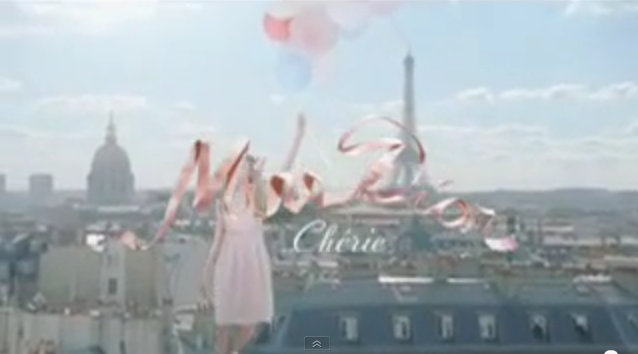
In
conclusion, as time passes the theatrical representation of beauty slightly
converts to a more natural image of strong sexuality, and the attraction of the
modern beauty is often achieved by portraying a free image which suits the busy
world we live in.
Subscribe to:
Posts (Atom)